Share subscription
Target Audience: Users, Stakeholders
Release version: 3.7.4
Introduction
This section describes the sharing of a subscription in Payway.
Requirements
A shareable subscription must be
- A valid package or campaign: Packages can be shared, campaigns on a shareable package will automatically inherit the sharing configuration from the packge.
- Only one sharing configuration: A package can only be assigned to one configuration.
- Integration must be based on the Payway Common Subscription System Integration in order for sharings on campaigns provisioned by the subscription system to remain intact upon campaign transitioning to normal.
Campaigns
Campaigns will automatically inherit the sharing configuration from the package it is based on.
A campaign that transitions to a normal price subscription will keep all shares made during the campaign subscription.
Subscription changes
When a shared subscription changes product, for example on an upgrade, downgrade, package change, retention or campaign transition, its sharings follow the subscription to the new product. The people it is shared with keep their access without a new invite. The PackageSharingMoved event is sent for each sharing that is moved.
- Accepted sharings are moved: Invites that have not been accepted yet are not moved, and end with the old subscription.
- The new product must be shareable: If the new product has no sharing configuration, the sharings are not moved and end with the old subscription. This is logged in the customer's account timeline.
- The new subscription must have started: If the new subscription starts later, for example a retention paid with an external payment provider, the sharings are not moved and end with the old subscription.
How to share a subscription (Sharer)
-
Go to my account, click "Share package"

-
Supply receiver emails. The number of receivers is determined from the configuration.

How to accept a shared subscription (Receiver)
-
If the user does not have an account hen will be required to create an account.
-
Go to my account, click "Accept invitation"

-
The receiver is provisioned the shared package

How to share a subscription from customer service (PAP)
Customer service can share a subscription on behalf of the customer. In PAP, open the customer, click the sharing icon next to the subscription in the left hand menu, and add the receivers. The form has two buttons, which decide whether the receiver gets an invitation email:
| Button | What happens | Event |
|---|---|---|
| Save | The sharing is saved as pending, and an invitation link is emailed to the receiver. The receiver has to accept the invitation themselves. | PackageSharingInitialized, which sends the invitation email. |
| Save and accept | If the receiver already has a Payway account, the sharing is accepted right away and no email is sent. If the receiver has no Payway account, it works like Save: the sharing is pending and an invitation link is emailed. | PackageSharingActivated if the receiver has an account, otherwise PackageSharingInitialized. |
Subscriptions that have not started yet
"Save and accept" is not available while the subscription has not started. A sharing saved on such a subscription is put on hold, and no event is sent until the subscription starts. The receiver then gets the invitation as with Save, and PackageSharingInitialized is sent.
A pending sharing is also accepted automatically when the receiver confirms a new Payway account, which sends PackageSharingActivated.
How can I edit the sharing configurations of a package? (Administrator)
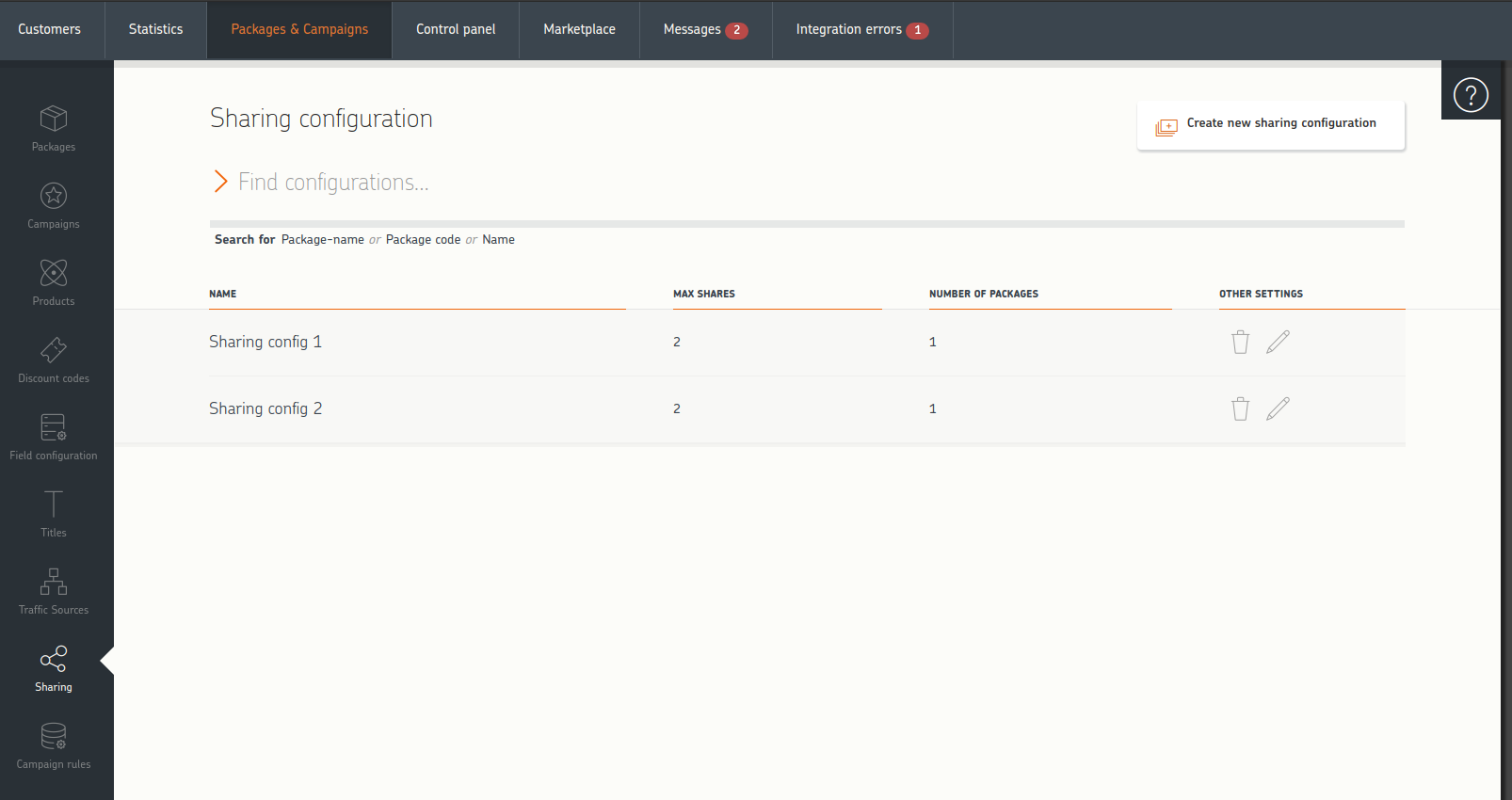
A configuration is no longer attached directly to a package. Instead you assign a package to a sharing configuration. Allowing you to assign many packages to a single configuration and not have to edit each package individually. You create sharing configurations from PAP.
Disable sharing for specific package
If you want to disable sharing for a specific package you simply remove the package from the configuration. To find which configuration you can search for it in the "Sharing configuration overview". See below. You can search for configuration name, package code, package name or package description.